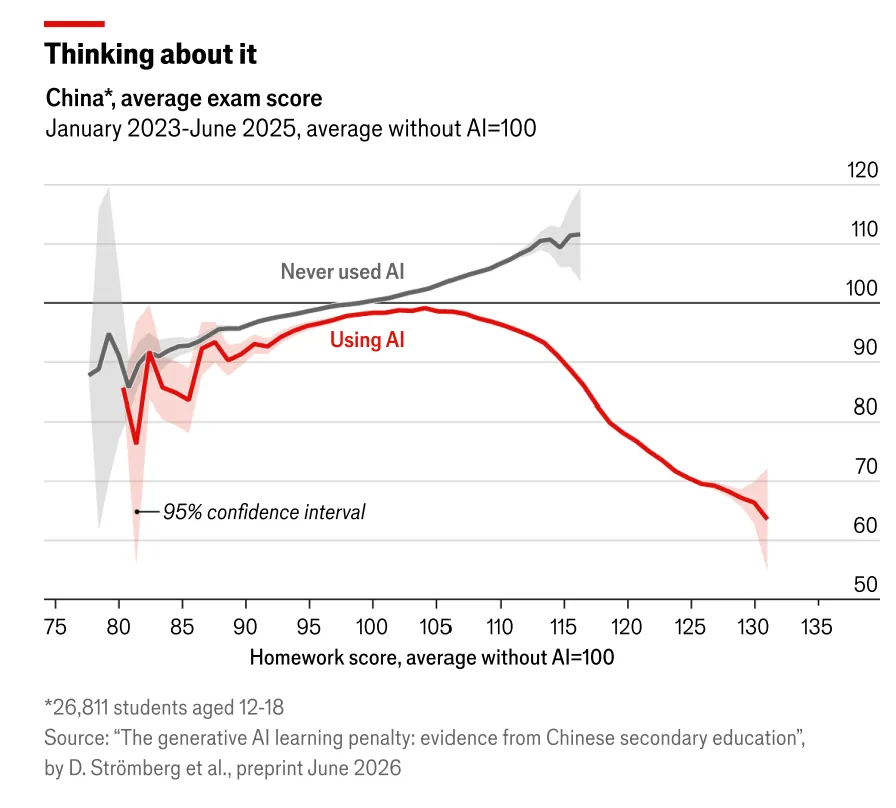
Generative AI clearly negatively impacts learning
Tuesday, September 15, 2026
Every educator should stop what they’re doing and read this article by Benjamin Riley. The impact generative AI has on learning is STUNNINGLY negative. Here are the highlights directly from Benjamin’s article:
- Between 2023 and 2025, approximately 80 percent of all students started using generative AI, and after just five months of use, approximately 50 percent of these students engaged in “full homework outsourcing,” meaning, they essentially stopped doing their homework independently and used AI instead.
- Over time, this caused significant learning loss as measured both on monthly closed-book exams and via the comprehensive high-stakes exams that China uses to determine high school and college placement for students. On those tests, by the end of June 2025, overall student performance fell by 24% on the former and 18% on the latter, a massive decline.
- What’s more, there is no evidence—none—of any corresponding learning benefit arising from students using AI.
- As such, the researchers state plainly that “our findings show that generative AI, which is likely to become a prevalent technology for education, has a substantial negative impact on student learning.” (My emphasis)
He gets into the details of the study in the remainer of the article and I encourage you to read the whole thing.
We should be grateful that this research came realtively early in the generative AI revolution, because we’ve seen this movie before. I remember being told throughout the 2010s that we should encourage students to use their phones in class and should design lessons in which students use them. After all, they’d always have their phones with them after graduation, they were “creation” tools, and they needed to learn how to use them effectively. But we’ve come full circle and realized that to maximize learning phones should be in a completely different location. I think we’re also finding that screens in general (Chromebooks and tablets) do not improve learning and often harm it. We are early enough that we can put the brakes on AI integration in classrooms before the damage is done.
To be clear, I’m not speaking from a pedestal and saying that I called it in the 2010s. I was right there on Twitter singing the praises of certain aspects of popular educational technology. Much of it became a necassary evil during Covid. Indeed, my master’s degree is in ed tech. However, I’m trying to learn from my mistakes. In five years I don’t want to be in the situation where we have all integrated AI as much as possible and realized that it’s actually bad for learning and need to unwind it. Like we’ve seen with Chromebooks, it’s difficult to reverse the inertia of anything that’s inegrated into daily classroom teaching. With this research and the failure of the last decade(+) of edtech dogma, we won’t be able to say that we didn’t know.
(image source: www.economist.com/graphic-d…)